Pentecost Through Pentecostal Eyes: A Pentecost Sunday Reflection
As Pentecost Sunday comes to an end for another year, it feels like a good moment to pause and reflect on what Pentecostals like me actually believe about Pentecost, about the baptism in the Holy Spirit, and about why we continue to hold that the fire of Acts 2 is still a promise for believers today. As Pentecostals, we treasure something both precious and powerful: not only that the Holy Spirit dwells in every believer, but that Jesus also baptises believers with the Holy Spirit for power, boldness, intimacy, and witness. And that distinction matters - not because it divides Christians into categories, but because it helps us understand the fullness of what God desires to give His people.
The Holy Spirit Dwells in Every Christian
Before we talk about empowerment, boldness, or any manifestation of the Spirit associated with Pentecost, we need to state something clearly: every true believer already has the Holy Spirit living within them. This is not a secondary blessing or a later upgrade in the Christian life; it is the very foundation of our salvation. Paul says it plainly in Romans 8:9: “And if anyone does not have the Spirit of Christ, they do not belong to Christ”. In other words, the Spirit’s indwelling presence is not an optional extra - it is the defining mark of belonging to Jesus.
The moment someone turns to Christ in repentance and trust, the Spirit takes up residence within them. The Bible describes this reality in rich and varied ways. We are born again by the Spirit (John 3:5-8), sealed by the Spirit as God’s own possession (Ephesians 1:13), and made into temples of the Holy Spirit (1 Corinthians 6:19). These are not poetic images meant to inspire us; they are truths meant to anchor us. They remind us that God has already drawn near, already made His home within us, and already begun the work of transforming us from the inside out.
And because that is true, we must also say this clearly: a believer who has not yet received the baptism in the Holy Spirit is not half-saved or spiritually inferior. The baptism in the Holy Spirit is not a badge of honour or a mark of spiritual elitism. The ground is level at the foot of the cross, and the Spirit is a gift, not an achievement. Salvation is complete through Christ alone. The Spirit’s indwelling is full, sufficient, and life-giving.
But Pentecostals also believe that, while the Spirit dwells within every believer, there is an empowering work of the Spirit that God desires to give for mission - not because Christ’s work is lacking, but because His generosity is overflowing.
The Pentecostal Understanding
This means that, for Pentecostals, the first experience of the Christian life - salvation - is the incoming or indwelling of the Holy Spirit, through Jesus Christ, to give us new life. This is where our human spirit which was dead to God is now made alive to Him and where the Holy Spirit comes to live in us. The baptism in the Holy Spirit is a second, subsequent experience - it is the receiving of the Holy Spirit to empower us for witness in the world.
This baptism in the Holy Spirit is a discernible, visible and experiential event and is distinct to, and takes place after, conversion (theoretically it could take place a long time after conversion, though the biblical norm would be for it to happen as close as possible to the salvation event). This means that, as per classical Pentecostal understanding, while you cannot be a Christian without the Holy Spirit indwelling you, you can be a Christian without Him empowering you - that is, it is possible to go about the Christian life, and even live a satisfactory Christian life, without seeking the empowerment of the Spirit.
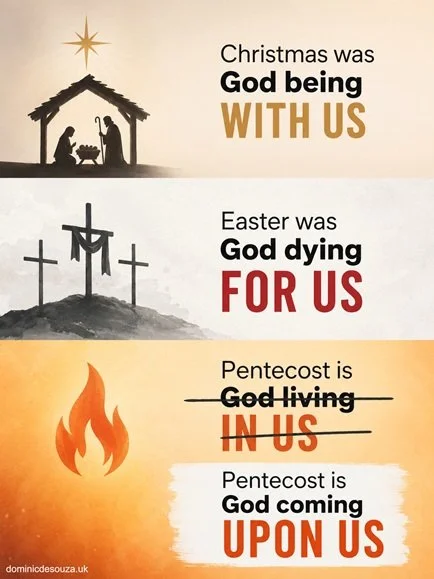
A little while ago I came across an image on Instagram that said, “Christmas was God being with us. Easter was God dying for us. Pentecost is God living in us”. And while that captures something true and beautiful in relation to Christmas and Easter, it does not quite express the full theological picture of Pentecost from a classical Pentecostal perspective. Many Pentecostals believe the disciples had already received the Spirit’s indwelling presence before Acts 2 (see John 20:22), while Pentecost itself was the moment the Spirit came upon them in power for witness, just as Jesus had promised in Acts 1:8 - so a more accurate parallel might be, “Pentecost is God coming upon us”, since “God living in us” properly belongs to the saving work of the Spirit at conversion.
Indwelling Is for Life, Baptism Is for Power
When Jesus spoke to His disciples in the days between His resurrection and ascension, He said something that should still make us pause. These were men and women who already believed in Him, who had walked with Him, who had confessed Him as Lord, and who had received His peace after the resurrection. In John 20:22, Jesus even breathed on them and said, “Receive the Holy Spirit”, signalling that the Spirit was already at work within them in a new and intimate way.
And yet, despite all of that, Jesus still told them to wait:
“Stay in the city until you have been clothed with power from on high.” (Luke 24:49)
“But you will receive power when the Holy Spirit comes on you; and you will be my witnesses.” (Acts 1:8)
The language is deliberate. The Spirit was already with them and in them, but Jesus promised an empowering that would come upon them. The distinction is not about spiritual hierarchy; it is about purpose. The Spirit indwells us for life with God, but He also empowers us for the mission of God.
That empowering arrived in Acts 2, on the very first Pentecost. The same disciples who had hidden behind locked doors were suddenly standing in the streets, proclaiming Christ with clarity and courage. Tongues of fire rested on them. They were filled with the Spirit. Peter, who had once trembled before a servant girl, now preached boldly to thousands. Something had shifted - not in their salvation, but in their strength.
This is why Pentecostal theologians speak of the baptism in the Holy Spirit not primarily in terms of emotion or experience, but in terms of empowerment. It is the Spirit equipping believers with what they need to witness faithfully in a world that often resists the gospel - not only with courage and conviction, but with supernatural enablement that goes beyond human strength.
It is power to speak when silence feels safer.
Power to pray when words run dry.
Power to endure when faith is tested.
Power to live boldly for Christ in the ordinary and the difficult.
Power to step into the supernatural - gifts, guidance, discernment, healing, and more - so that Christ is made known not just through our words, but through the Spirit’s unmistakable work.
The baptism in the Spirit does not replace the indwelling of the Spirit; it builds upon it. It does not make us superior; it makes us surrendered. It does not create two kinds of Christians; it creates a Church ready to bear witness.
A Pattern Woven Through Acts
Pentecostals do not hold this view out of sentiment or nostalgia; we hold it because we believe the book of Acts consistently shows believers receiving a distinct empowering work of the Spirit after they have already come to faith.
In Acts 8, the Samaritans believed the gospel and were baptised in water, yet Peter and John still travelled from Jerusalem to pray for them to receive the Holy Spirit. The text makes a clear distinction: they had welcomed the message of Christ, but the Spirit had not yet come upon them in the way Jesus had promised.
In Acts 19, Paul meets a group of “disciples” in Ephesus and asks a striking question: “Did you receive the Holy Spirit when you believed?” (Acts 19:2). That question only makes sense if Paul expected that receiving the Spirit in power was a meaningful and recognisable experience - something that could be asked about, prayed for, and received.
Across Acts, the pattern is not rigid, but it is unmistakable:
Salvation
Ongoing surrender
Empowerment by the Holy Spirit
Not every account looks identical, but the theme is clear: God desires to clothe His people with supernatural power.
Some Christians maintain that the baptism in the Spirit is not subsequent to conversion but always simultaneous with it (or even that it is the same event as conversion). But several passages in Acts become difficult to explain. The disciples in Acts 2 were already followers of Jesus. The Samaritans in Acts 8 had already received the word of God. The Ephesian disciples in Acts 19 had already believed, yet still encountered a distinct receiving of the Spirit accompanied by spiritual manifestation.
Pentecostals are not trying to create a theological novelty; we are simply taking such Bible passages seriously as part of the normal Christian life. They show us that the Spirit’s work is both foundational at conversion and empowering for mission.
Keep Seeking, Stay Filled, Pentecost Is Still Happening
One of the quiet tragedies in modern Christianity is how easily we learn to live with a low spiritual appetite. We settle for information without transformation, routine without fire, and a version of discipleship that keeps us afloat but rarely draws us deeper. It is seldom intentional; it is simply what happens when the pressures of life and the familiarity of faith begin to dull our hunger for more of God.
Pentecost interrupts that drift. It reminds us that God still fills thirsty people, and that the Spirit is not given once for us to admire but continually for us to receive. Jesus’ promise still stands: “How much more will your Father in heaven give the Holy Spirit to those who ask him!” (Luke 11:13). Asking is not striving; it is opening. It is the posture of a heart that refuses to live on yesterday’s encounter - a heart that embraces the fullness of what God delights to give.
This is why Paul urges us, “Be filled with the Spirit” (Ephesians 5:18) - a phrase that carries the sense of ongoing action. Keep being filled. Keep receiving. Keep making room. The Spirit-filled life is sustained not by hype or intensity, but by a steady rhythm of communion with Jesus: prayer that reorients us, worship that softens us, repentance that frees us, obedience that shapes us, Scripture that grounds us, and a yielded heart that stays attentive to God.
And all of this rests on a simple truth: Pentecost is still happening. The same Spirit who filled the upper room still fills hungry hearts. The same holy fire that ignited the early Church still burns in ordinary believers who dare to ask for more. Jesus has not stopped baptising His people with power from on high - God is still coming upon His people with boldness, fire, gifting, and supernatural strength to proclaim Christ to the world.
So if you have never experienced the baptism in the Holy Spirit, come with openness, trust and surrender. And if you have experienced it before, do not live on the memory. Keep seeking fresh filling. Keep tending the flame. Keep making room for the Spirit’s work in your life.
Pentecost is not a moment behind us; it is a promise before us - a reminder that the power of the Spirit is offered to every believer who longs to walk in the fullness of God.